







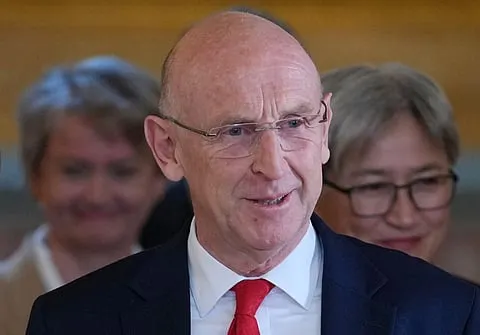
COVENTRY, England — September 7, 2026 — Britain’s Finance Minister John Healey has used his first major speech since taking office to present a more optimistic outlook for the country’s economy, while acknowledging the difficult decisions facing the government ahead of its upcoming budget.
Speaking at a manufacturing centre in Coventry, central England, Healey outlined plans to give city regions greater powers to attract private investment as part of the government’s wider programme to transfer economic decision-making away from Westminster.
The finance minister also reaffirmed his commitment to fiscal discipline, reducing regulatory costs for businesses and tackling the rising cost of living.
Government Targets Lower Business Costs
Healey announced an ambition to reduce regulatory costs by 25% before the next general election, expected in 2029.
The government says reducing unnecessary regulation could help businesses invest, expand and create jobs while making it easier for companies to operate in Britain.
The minister also said city regions would receive greater powers to attract private capital, with the aim of encouraging economic growth beyond Britain’s traditional economic centres.
“While Britain’s growth trajectory has been weak, this must now change,” Healey said, pointing to stronger economic growth during the first half of the year and indications that productivity may finally be improving after years of underperformance compared with other advanced economies.
Jaguar Land Rover Job Cuts Highlight Economic Challenges
However, the government’s optimistic message was overshadowed by an announcement from Jaguar Land Rover (JLR) that the company plans to cut approximately 4,000 jobs worldwide over the next two years.
The announcement came as Healey was delivering his speech and highlighted the challenges facing Britain’s manufacturing sector.
Asked about the potential impact on British workers, Healey said the development demonstrated the importance of ensuring that economic growth is spread across the country rather than concentrated in a small number of major cities.
He argued that Britain needs a broader economic strategy capable of supporting businesses and employment across different regions.
Budget Decisions Loom
Healey’s speech comes less than two months before his first major budget, scheduled for October 28.
The upcoming budget is expected to involve difficult decisions over taxation, government spending and the country’s finances.
Healey declined to provide details of his tax plans, despite growing speculation over whether the government may need to raise additional revenue.
The government is facing pressure from several directions, including higher debt-servicing costs, increased spending commitments and concerns about the economic effects of elevated energy prices.
Commitment to Fiscal Discipline
Healey also reaffirmed his support for the government’s existing fiscal rules.
The rules include a long-term objective of ensuring that day-to-day government spending is covered by tax revenues by the end of the decade.
However, meeting those targets could prove challenging as the government considers increased spending on areas such as social care and defence.
Healey acknowledged the pressure facing public finances and stressed that controlling government expenditure would remain a central priority.
“Staying true to our values means being honest about the need to control government spending,” he said, pointing to the increasing cost of servicing Britain’s government debt.
New Funding for Northern Businesses
As part of his economic plans, Healey announced that £150 million already allocated through the British Business Bank will be directed toward businesses in northern England.
Individual investments ranging from £5 million to £15 million are expected to be used to attract additional private-sector capital into the region.
The initiative is intended to strengthen investment in northern businesses and support the government’s goal of spreading economic growth more evenly across Britain.
Infrastructure and Planning Reforms
Healey also outlined plans to make it more difficult for legal challenges to delay major infrastructure projects, particularly challenges based on environmental concerns.
The government will additionally examine the high costs associated with developing new railway infrastructure as it seeks to improve connectivity while controlling public spending.
Healey said the government needed to move away from excessive consultation and focus more heavily on delivering projects.
“The role of government is to act,” he said, adding that he wanted to end what he described as a culture of prolonged consultation within the Treasury and wider government.
Opposition Questions Government’s Strategy
The government’s economic message has already attracted criticism from the opposition Conservative Party.
Andrew Griffith, the party’s finance policy chief, accused Healey of offering little change from the approach of his predecessor, Rachel Reeves.
The opposition argued that promises of stronger economic growth would need to be matched by concrete policies capable of delivering higher productivity, investment and living standards.
Looking Ahead
Healey’s speech marks an attempt by the government to shift the economic narrative toward growth and investment ahead of a potentially challenging budget.
With Britain’s public finances under pressure and businesses facing uncertainty over costs, taxation and regulation, the October budget is expected to provide a major test of the government’s economic strategy.
For Healey, the immediate challenge will be to balance his promise of stronger economic growth with the need to maintain fiscal discipline and provide sustainable funding for government priorities.
The government will now face increasing scrutiny over whether its plans can translate its optimistic economic vision into measurable improvements in investment, productivity, employment and living standards.