









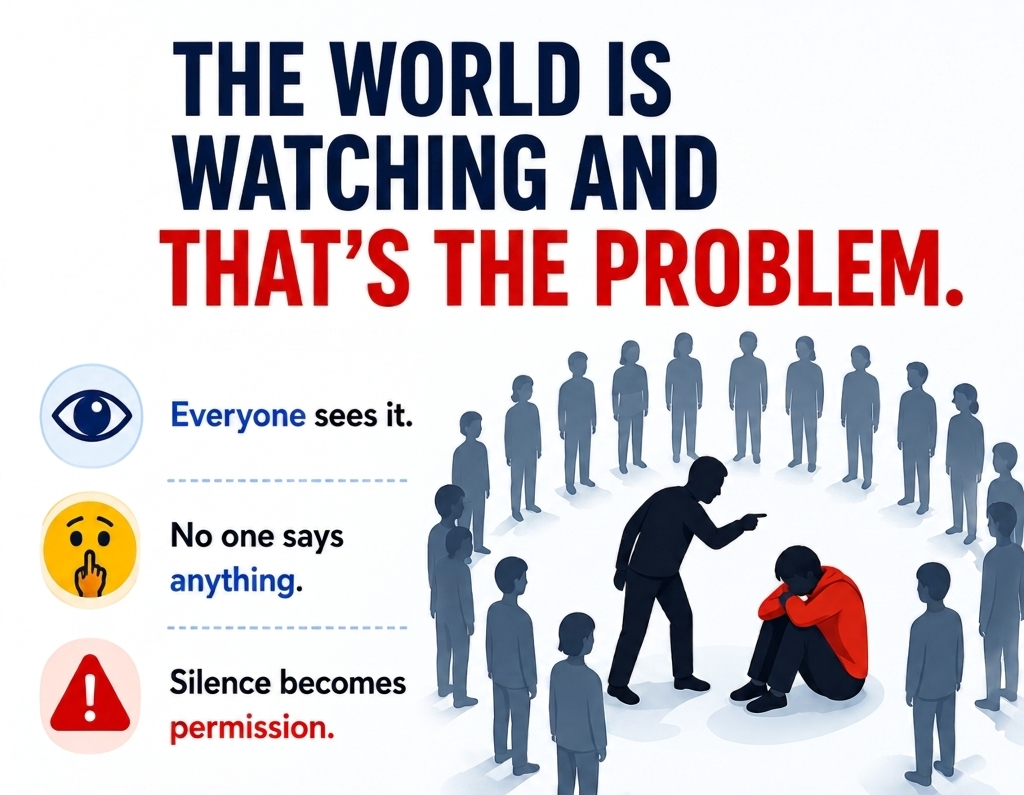
One of the most persistent forces working against progress is not active wrongdoing. It is passive observation. It is the decision to watch and do nothing. The onlooker who sees and says nothing. The institution that knows and does nothing. The leader who witnesses harm and waits for the issue to die down itself. This is the bystander effect.
Think about those awkward workplace moments when a colleague makes a derogatory comment disguised as a joke, or clearly tries to sabotage a coworker and calls it an “oversight.” Everyone in the room sees it. Everyone is watching. But because no one speaks up, the behaviour slides by and the silence becomes permission.
Or consider an organisation that knows its operations are not environmentally sustainable but delays making meaningful changes. Rather than measuring itself against what it could do, it watches competitors with even larger carbon footprints and tells itself it is doing fine. Watching others do worse becomes a reason not to do better. The organisation is not denying that a problem exists; it is waiting for someone else to go first.
In these moments, whether it’s a toxic workplace or an organisation watching competitors instead of examining itself, the common thread is the same. Everyone has positioned themselves as a spectator. And spectators, by definition, do not act.
People are not passive because they are indifferent. They are passive because the architecture of crowds, institutions, and norms creates conditions in which passivity is the path of convenience or least resistance. Social psychology offers a useful explanation for why this happens.
When harm occurs in a crowd, people assume someone else will step in, so no one does. The more people watching, the easier it is to feel like a bystander rather than a participant. People scan the room for cues, and when they see others staying still, stillness feels like the right response. Some tell themselves their intervention will not matter. Others are afraid of getting it wrong. The result is a room full of people watching, each one waiting for someone else to move first.
For individuals, the shift starts with one recognition: you are not just a witness. “Someone should do something” very often means “I can do something.” You do not need a perfect answer. Sometimes asking “Can you explain what you mean?” is enough to interrupt a harmful pattern and move a conversation toward accountability.
One person choosing to act can break the assumption that everyone watching agrees with what they see. That is usually enough to move others.
The same applies to sustainability. The right question is not “Are we better than others?” but “Are we doing what we should?” That shift matters beyond ethics, it is also what protects the business long term.
So, change the conditions, assign responsibility directly, make intervention safe, model action from the top, name what everyone is privately thinking, and the same people who were watching will move.
Passivity does not communicate neutrality. Psychologically, it communicates permission. Every person watching and saying nothing tells the room: this is acceptable; this can continue; worse is possible. Silence is not the absence of a message. It is a message.


